
Chapter 1: Planetary Collapse
Today is Saturday. My mum, as always, has sent me to the market. I don’t really like this chore. Mum sends me in the hope that the shopkeeper will take pity on me and give us a bit more than we can afford. You walk past the rows of food, but you can only buy bread and a couple of vegetables. Once every cycle, we can afford a bit of meat. I also have a tendency to constantly think about other people, and seeing other poor folk makes me feel very sad. I put myself in the shopkeepers’ shoes and realise that I wouldn’t want to be in their position – having someone come up to me and buy something from me. Although I don’t think that applies to market traders. They seem to be happy to see everyone, all the time.
The only thing that makes me go to the market is our traditional Martian pies. Mum always lets me buy a couple in return for doing the shopping at the market. That stall is my absolute favourite. I save my visit to this stall until last, to take my mind off my sadness.
So today, having sorted out all my shopping, I head for the stall selling Martian pies. Even as I approach it, I can smell that sweet aroma, which follows you first to the stall, and then accompanies you from there all the way home. Another tell-tale sign is the red door. When you push it open, you step into a small room where everything is made of Martian limestone and the shelves are lined with Martian pies. There are two varieties: with caraway and with cinnamon. My favourites are the cinnamon ones. I always buy two: one for myself and one for Mum.
The shopkeeper has known me since I was a child, so we just nod to each other in greeting. He immediately goes to fetch two cinnamon buns, whilst I’ve already got the exact change in my hand. The two little sweet buns cost exactly 14 kopecks.
As I leave the shop, I head straight home as Mum told me to, because they might come along and take all the food. I’m always a bit more cunning: I tag along with someone I know and try to strike up a conversation, or at least keep up with them.
That’s exactly what happened this time. As I left the shop, I spotted my neighbour Avari and immediately tagged along with him. I was lucky – he’d finished his shopping too, and we walked home together. Avari is five cycles older than me. He’s tall and lanky. He has shoulder-length fair hair, which he’s constantly tucking behind his ears. I always find him interesting, as he knows a lot and is always telling me about our former civilisation. Just like now.
‘I see you’ve only bought a little bit of food. Would you like me to tell you about our ancestors, who lived in abundance?’ Avari looked into my food box, which was secured in front of me with two ropes.
‘I’ve been dreaming of hearing that. That’s why I ran over to you. I always love your stories,’ I said excitedly.
And he began to tell us:
‘Many cycles ago. We lived on the surface of our beloved planet. Everything was there. There was natural light, emitted by our mother star.
Thanks to our mother star, everything on our planet flourished. Here on Mars, there were vast numbers of plants. Everything was in abundance.
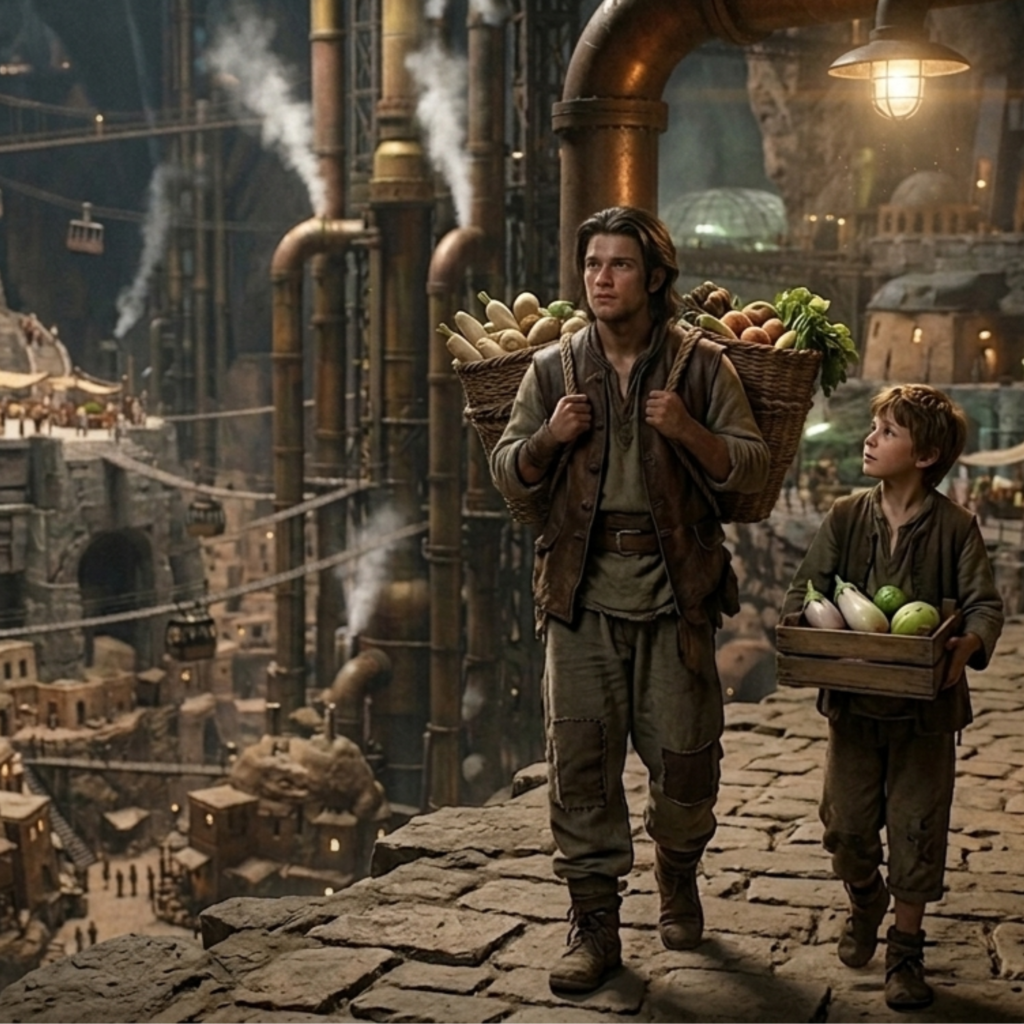
Our ancestors built the greatest civilisation of that era. Science had advanced to such a level that we were able to leave the confines of our atmosphere and journey towards our mother star. We studied it, just as we did many other planets. There are countless such worlds out there.
But one day, a terrible day came for all our brothers and sisters. In an instant, everything changed. Everything ceased to exist.
‘Please tell me what happened?’ I asked Avari. This moment had interested me more than anything else for many cycles. I wanted to find out as much as possible about it. After all, it was precisely this moment that changed our whole lives. I had a feeling that I needed to know this. It seemed to me that I might be able to change it and that we would once again live in abundance.
He continued:
‘One truly dreadful day, a meteorite crashed into the nearest planet. It veered off its cyclic orbit and headed towards Mars. Mars also veered off its cyclic orbit and ended up too far from our parent star. Everything froze instantly!’
-Budimir, – my mum interrupted us just as things were getting interesting, calling me over to her.
I was a bit disappointed, as I’d wanted to find out more about everything. I was preoccupied with the question of what had happened back then. After all, we might well be living in a completely different world now.
‘Mum, Avari told me about our past. About the great cycles of our civilisation. It’s so fascinating. I want to find out more,’ I said enthusiastically.
‘My dear Budimir, I used to love hearing about our great cycles too. You must ask Grandad about it. Everything I know about the great cycles, I learnt from him,’ Mum told me, looking at me with tender, loving eyes. ‘You know, I want to cook “Beron” today. You can take some of the food over to Grandad later and have a chat with him about it.
‘Thanks, Mum,’ I cried out with joy. I’ll get to find out more about our Great Cycles.
‘Just don’t forget to tend to your plant first. And I think Grandad will be very pleased if you help him with the housework,’ added Mum, taking the shopping from my hands.
I decided to follow Mum’s advice and look after my plant whilst she was cooking, so that I’d have the evening free and could pop round to Grandad’s.
In modern civilisation, every child, upon reaching 6 cycles, is entrusted with a plant. The plant must be looked after for the next 12 cycles, after which it is planted in the communal garden, as it is considered strong enough to survive without supervision. During the first year, we must spend two-thirds of our waking hours with our plant. This is because it is very difficult to grow a tree underground. The first year was the most difficult for me. You are given a small seedling and must plant it in the ground. Then come long months of searching for the right wavelength, suitable for your plant’s growth. You have to constantly ensure that the plants receive the necessary amount of water and carbon dioxide, and that the temperature and lighting are just right. Over the next six cycles, it’s a little easier to look after the plant. During this time, you spend only a third of your waking hours with it. And during the final five cycles, you simply watch as the plant becomes stronger, checking on it briefly just three times whilst you’re awake.
My plant is currently in the final stage of care. In fact, I’ve already lived through 12 cycles on Mars. At this age, we acquire knowledge at the Centre of Light, or as some call it, the ‘House of Knowledge’. I also do some part-time work on the plantations. This is the most common job for children. All children from poor families have to work. Only a few get a job in a shop, whilst the majority look after the plants left behind by our ancestors. Since adults, upon reaching 18 cycles, hand over their plants to the plantations and go to work in the mines to extract energy stones, or to monitor generators and other life-support systems.
Budimir went to see his plant in the courtyard. Plants were now one of the most important aspects of life on Mars. Without them, there would be no air here. That is why every resident was taught from an early age how to look after plants.
The entire civilisation of Mars was now located in an ultra-deep mine. When disaster struck on Mars, people took refuge in this mine and carved out their city from Martian limestone. Each home was a cave in the ground. Some residents dug out several rooms, but most dug out just one room, and the whole family lived there. The family’s plants and various tools were kept above the cave. This area was considered the courtyard.
Budimir kept his plant in a special capsule. All children initially receive a small capsule from the central government, but afterwards they have to make their own capsule, as the growth rates of each plant species vary. Budimir has already had to change the size of his capsule twice. Budimir was very keen on technology, a talent he inherited from his mother, who grew up in a family of engineers. For his plant, he built an automatic system to supply carbon dioxide—which he drew from a system installed in the house—as well as controls for temperature and water supply. He also fitted a battery to the capsule, so that if the power were to cut out, his plant capsule would still function as required. All he had to do was ensure there was always water in the reservoir. The water was usually fetched from an indoor waterfall. There were several of these in the city. They’d stumbled upon them whilst tunnelling the mine outwards.
Budimir walked over to the capsule and checked the water. He compared all the parameters with his handheld controller. Having satisfied himself that the temperature, battery charge and carbon dioxide level were all correct, Budimir went into the house. A salad, already chopped, was sitting on the table. And Budimir’s mother, Gara, was finishing preparing ‘Beron’ on the energy stones.
‘It’ll all be ready in a moment; go and wash your hands,’ Gara said to her son.
Budimir obeyed his mother and went to the water cistern that had been dug deep into the ground. It was a small cistern: one metre long and 20 cm wide. The cistern was about 50 cm deep. Every house had a water tank like this; some people dug them out of limestone, whilst others built them from stone. Kneeling down, Budimir opened the side valves and water flowed from the tank into a smaller one, where he cupped his hands to catch the water and began washing his hands. Afterwards, the water could be drained into the central sewer system, where it flowed into treatment tanks and was used to irrigate fields and greenhouses. The residents filled their domestic tanks themselves, carrying water from the internal waterfalls. This was quite difficult, so the Martians used water sparingly. Budimir, too, always tried to wash his hands quickly.
He dried his hands and went to help his mother set the table. ‘Beron’ was placed in the centre. ‘Beron’ was a very popular dish. After the planetary collapse, a small number of edible plants had been saved. One of these plants was the turnip. ‘Beron’ was made from turnips with the addition of mushrooms and butter. If there was a piece of meat to hand, it could be added to the dish as well. Usually, dinner consisted of simply boiled turnips, but as it was mushroom season, Gara tried to make ‘Beron’ for her son as often as possible. And whilst the ‘Beron’ contained baked turnips, for the salad his mother used fresh turnips and added carrots to them.
Mother and son sat down to dinner. Budimir was in a hurry; he wanted to get to his grandfather’s as soon as possible and ask him about the planetary collapse.
Gara could see her son’s impatience. Before she’d finished eating, she stood up and put a small portion of ‘Baron’ into a jug. She placed the jug in her knapsack. And she said:
‘You’ll have to take it there quickly so it doesn’t go cold.’
‘Yes, I will,’ replied Budimir, finishing his meal.
‘You’re such a clever boy. I’m sure you’ll get answers to all your questions.’
With that, Budimir picked up the knapsack and ran towards his grandfather’s house.
His grandfather lived in another part of the underground city. To get there, one had to cross the Quarter of Lights and the Quarter of Potters. In modern Martian civilisation, the whole city was divided into quarters where people of the same trade lived. It was believed that if people of the same trade lived side by side, their craft would thrive and improve.
The Quarter of Lights was home to those who made lamps that produced light from energy stones.
In the pottery quarter, potters produced crockery, jugs, glasses and other household items.
From early morning, traders arrive in these quarters to buy up the goods, which they then sell at the market. This is how goods are exchanged between one district and others at the central market.
Residents are not allowed to buy goods directly from the craftsmen. By law, goods can only be purchased through traders. Nobody likes the traders, as they buy goods for a pittance and sell them at triple the price. However, they do have their own responsibilities. In the event of a breakage or fault, the trader must either refund the full cost of the goods or replace them with a fault-free item at no extra charge.
Budimir’s grandfather lived in the engineers’ district. This district was home to those who came up with new inventions for civilisation. The engineers were also responsible for repairing all the systems in the mine.
Sergei – Budimir’s grandfather – worked on the system for venting excess carbon dioxide from the mines. It was one of the most complex systems in the mine. It captures the excess carbon dioxide and releases it onto the surface of Mars.
Problems with the system begin in winter. This is because carbon dioxide freezes on the surface of Mars, making emissions impossible. However, during this period, the Martians try to plant new seedlings and use the excess carbon dioxide to aid plant growth or store it in reserve tanks. This continues until the onset of the Martian spring. Then the frozen carbon dioxide on the surface of Mars thaws, creating weak spots in the ice. This is what they exploit: the engineers then increase the flow of carbon dioxide, and it bursts out from beneath the frozen layer like a geyser. In this way, the system is restarted and continues to function until the following winter.
Now, however, Sergei is unable to do this, as he lost his hand in an accident involving the carbon dioxide system. One spring day, the engineers were starting up the system for the new season, but the valve jammed and Sergei had to open it manually. Unfortunately, when he opened the valve, he didn’t manage to pull his hand out of the carbon dioxide exhaust system in time. His hand was crushed by that ill-fated valve. They were unable to pull his hand out of the system until the tank had emptied. This took a very long time, and gangrene set in; his hand had to be amputated. Since then, Grandad Sergei has been working solely as a consultant on the system or as a trainer. He always tells the story of what happened to him to remind young engineers to be careful.
Sergei loved his daughter and grandson dearly. He was always trying to persuade them to move to the engineers’ district. After all, they lived in the dirtiest part of town – the miners’ district. But Gara always refused. She still harboured the dream that one day her husband would return. After all, it was because of him that she had moved to the miners’ district in the first place. Daniil, Gara’s husband and Budimir’s father, was taking part in the mine excavation. During one of the shifts, at the spot where they were digging, the mine collapsed, burying the excavation site and everyone who was working there that day. They were quite deep inside the mine. Other miners tried to dig the shaft open again, but as they had not managed to do so within the first three days, the commune decided that the miners should get on with their proper duties and extract ore for civilisation, rather than digging out those who might already be dead. The excavation work is progressing very slowly at the moment, as the miners can only carry it out in their spare time. But many no longer believe that anyone could have survived. It has already been two months since the tragedy.
‘When are you and Mum coming to stay with me?’ said Sergei when he saw Budimir. ‘I miss you both. I’d love to see you every day. How are you getting on?
‘Hello, Grandad. We miss you too,’ Budimir exclaimed cheerfully, but then his voice dropped. ‘But you know Mum doesn’t want to hear about it just yet. And it’ll be hard for me to leave there. I miss Dad terribly.’
‘Perhaps moving house will be just the remedy you need?’ said Grandad, keen to change the subject as quickly as possible. ‘Let’s go inside. I see you’ve brought me something!’
‘Mum sent this. She made “Beron” today,’ said Budimir as he entered Grandad’s house.
‘Oh, how I love her “Beron”. It’s definitely the tastiest on the whole of Mars,’ said Sergei, taking the jug from the boy’s hands.
‘Grandad, I’ve come to see you on business,’ Budimir decided to begin.
‘So it’s not just for fun, then?’ Sergei replied jokingly. ‘And here I was hoping my grandson had missed me and had come round simply to see me.’
‘That too,’ said Budimir, realising his grandfather was joking and deciding to play along.
‘Well, what’s on your mind?’ asked Sergei, now with genuine interest.
‘Please tell me about the planetary collapse. Mum said you know exactly what happened there.’
‘And that too,’ Budimir said, realising his grandfather was joking, and decided to play along.
‘So what’s got you so worked up?’ Sergei asked, now genuinely interested.
‘Please tell me about the planetary collapse. Mum said you know exactly what happened there.’
'I might not know everything. But I’ll tell you what I do know,' — Sergei began his story, pouring ‘Beron’ into a cup.
... It happened a very, very long time ago. Billions of years ago. Back then, our civilisation was highly developed. It was, so to speak, living through its golden age.
People lived on the surface of Mars at that time. Mars was a paradise for life back then. Everything was in abundance. People back then built large cities out of metal. Huge skyscrapers were erected from iron structures. Ore was extracted from mines. At the centre of the city there was always a pyramid, serving as a source of energy. The pyramid was always the tallest structure in the city. Streets radiated out from its base. From a bird’s-eye view, it resembled the rays of the sun, radiating in great numbers from the pyramid in all directions. Right at the start, near the pyramid, the tallest buildings were constructed, and as one moved further away from the pyramid, the number of storeys in the buildings decreased. Outside the city, only single-storey buildings could be constructed.
There were a great many parks in these cities. Every rooftop was used as a garden where you could go out and have a cup of tea.
It was a combination of iron and plants.
The layout of the city was also interesting. Around the pyramid stood the buildings of various organisations and businesses. Then came the market district, where you could buy food, clothes, various tools and so on. Next were the residential areas; some people preferred to live in multi-family houses, whilst others had their own homes. Beyond the city limits were entertainment hangars. People went there to relax after a stressful day’s work. Initially, everyone headed towards the centre, and afterwards they went out into the countryside.
This layout wasn’t random. People back then made even more active use of energy stones. The pyramid was made up entirely of them. Industry and organisations, as the most energy-intensive sector, were located closest to the pyramid. Energy was channelled to them with minimal loss; next came the markets, which also required energy for cleaning, collection, processing and other activities. Residential areas and entertainment venues consumed the least amount of energy and were therefore situated furthest from the pyramid.
A typical day for people back then consisted of eating and taking their children to the House of Knowledge – or, as it was known at the time, the ‘Giteliki Tun’ – where they received all the essential information they needed for life. The houses of knowledge were situated in the same block as the three-storey residential buildings. This meant people could take their children to the house of knowledge much more quickly, whilst those living in single-storey houses would take their children there a little later. Once the children had been sent to the house of knowledge, everyone hurried off to attend to their duties. Each person received their calling upon leaving the house of knowledge. Leaving the House of Knowledge took place at the 25th cycle of a person’s life. It was at this point that a person was considered to have acquired sufficient knowledge and to be ready to contribute to society. Whilst attending the House of Knowledge, everyone could try their hand at every profession available on Mars. Thus, with each cycle, a person delved deeper into one subject or another, eventually receiving their calling. From then on, they devoted themselves solely to their calling. Every month, there was a community meeting for each calling, where problems and solutions were discussed. So people would pursue their calling until the evening, and afterwards they would pop into the market, buy some ready-made food and hurry to collect their children from school. Then they would head home or out of town to enjoy themselves. The entertainment centres also had dining areas where families could meet, eat and socialise around large tables; people could go dancing or singing. It was also possible to take part in various types of handicrafts. Many people practised techniques for awakening their inner strength and so on. There were animal parks where you could interact with the animals, feed them and look after them. Many people had their own pets there, which the centre looked after during the day, whilst in the evening the owner could come along to play with and look after their pet themselves. Afterwards, everyone went off to rest and sleep, to recharge for the new day and make a positive contribution in their chosen field.
Incidentally, the most interesting calling was that of the seers. These people were engaged in speculating about what the future might look like. They tried to imagine various themes and subjects. It was the seers who attended the commune meetings and presented a futuristic vision of this calling. They would demonstrate possible paths of development. They would look at developments in the short term, whilst also attempting to make predictions hundreds of cycles into the future.
But one day, something happened that no one could have foreseen. It was the collapse of the planets.
Our scientists were monitoring a huge asteroid heading towards Mars. At that time, technology had advanced to such an extent that we were able to fly beyond the boundaries of our atmosphere, deep into the universe. Detectors were installed on the asteroid to accurately predict its trajectory. When the asteroid entered the solar system, it became clear that a collision was inevitable. Engines were developed to alter the asteroid’s trajectory. However, by the time they had been built and fitted to the asteroid, it was already very close to Mars, so it was decided to deflect it slightly and allow it to collide with Earth. Into the planet that lay ahead of Mars as seen from the Sun. It was agreed that Earth would take the brunt of the impact, thereby saving Mars.
The Martians decided to sacrifice Earth. By then, Earth had been studied inside and out. It had plenty of resources, plants and animals, and its atmosphere was suitable for humans. The only difference was that it was much warmer there, as Earth was only 145 million kilometres from the Sun, compared with Mars, which was then 150 million kilometres from the Sun.
When our ancestors were able to travel beyond the boundaries of our atmosphere, we immediately set off for Earth. Numerous missions were carried out on Earth. Earth had always fascinated Martians. It could be seen with the naked eye in our sky. Earth influenced our planet, just as Mars influences it. But it was uninhabitable because of the monsters that lived there. They were extremely dangerous. There were hundreds of species of these monsters on Earth. Some fed only on plants. They did not pose much of a problem for humans. The predators, however, were dangerous. We couldn’t cope with them. These monsters were five to six times taller than a human. There were also smaller monsters, but they were even more treacherous. They were much faster than humans. Many missions ended in the loss of the crew, and so it was decided to leave Earth. And not to attempt to colonise it. We called these monsters ‘dinosaurs’. As these monsters posed a danger to us, we decided to sacrifice them as well.
So the asteroid was moved slightly by its engines and crashed into Earth a day later. Earth acted as a shield for us. The only thing we hadn’t taken into account was that Earth had shifted out of its orbit and was heading towards Mars. People held out hope right until the very end that Earth would pass close by without hitting Mars. But Earth left the Martians no chance at all. During the collapse, Mars was knocked out of its orbit. Earth came to a halt. Mars, meanwhile, began to move away from the Sun at great speed. This happened because Earth was much larger than Mars. Many people had been evacuated to ultra-deep mines even before the collision. Animals, plants, machinery and energy stones were transported to the mines. Another group of Martians left the Martian atmosphere in spaceships. Their fate remains unknown to us. There are only speculations that they ran out of oxygen and energy stones, as they could only take a very limited amount of food, plants, animals and stones with them. And since no one has made contact with us since the collapse, it can be assumed that they were scattered by the shockwave and perished in space.
Everyone who had taken refuge in the mines spent the next 40 days in the midst of tremors. During this time, sadly, many also lost their lives. Many mines collapsed due to the planet’s tremors. After 40 days, calm returned. But other changes had taken place on our planet. The atmosphere on the surface became uninhabitable. It felt as though the Earth itself had destroyed our atmosphere. But that was not all. Once the shaking stopped, an instant freeze set in. The temperature on the surface changed instantly and has still not returned to the levels our planet used to have. And in all likelihood, it never will.
All the plants on the surface froze and died out. Over time, all the buildings rusted and crumbled.
Down here, we had to build everything from scratch. We went as deep as we could and began connecting the shafts to one another, expanding outwards. It wasn’t easy. Very often, whilst tunnelling, people would come across underground water sources, and an entire tunnel could be flooded. It was only with time that we managed to get everything under control. We really began to expand. Millions of years passed in this way, and the civilisation that exists today took shape.
We were far luckier than those who had flown into space. We had access to energy stones. We began mining them again. This enabled us to generate energy for plants, for machinery, for cooking, and for other needs. It helped us to make contact with other Martians from different mines. The population began to grow. We grew stronger.
This is how a new system of governance and a system of neighbourhoods came into being. To ensure that knowledge did not die out, we established neighbourhoods. Each neighbourhood is responsible for its own craft. There, knowledge is passed down from generation to generation. Generally, women follow their husbands’ lead, and this determines a child’s future. The child takes up their father’s calling. The family has taken on great importance in these circumstances. The more relatives you have in different neighbourhoods, the better off you’ll be. Although it’s the merchants who have risen to power. These are the people with the most relatives across all the neighbourhoods. This gives them the opportunity to obtain goods and trade them. They’ve also created a monetary system, which didn’t exist on Mars before. As a result, every vocation has acquired its own value. Some became cheap, whilst others became expensive.
Nowadays, it’s mainly the traders who make all the decisions.
‘You know so much!’ Budimir said with great respect, ‘Have you ever been to the surface, even once?’
‘No, I haven’t. There’s nothing to see there now. Just rust, lime and cold.’
‘Is there any way to get out there?’ Budimir persisted.
‘No, there’s no way at all. It’s all sealed off. There are only carbon dioxide vent channels. Everything else is completely sealed off,’ Sergei shook his head. ‘And there’s nothing to do there anyway. There’s hardly any atmosphere left, after all.’ It’s all filled with carbon dioxide.
‘But I’d love to visit there just once. Just to see what it’s all like. To look up at the sky and out into the endless distance,’ Budimir mused.
‘Well, you’re a romantic,’ Sergei smiled. ‘Isn’t it about time you went home, romantic? Your mum will be worried!’
‘Thank you, Grandad, for the story. I want to find out everything. And when I grow up, I’ll definitely visit the surface of Mars,’ Budimir declared firmly.
‘You’ll manage it all. I’m sure of it.’ Sergei hugged his grandson close. ‘Just be careful.’
Sergei didn’t take his grandson’s words too seriously. He knew that not all childhood dreams remain relevant in adult life. Everyday life takes over, you worry more about your family and loved ones, and your knowledge becomes the limit to your imagination.
Chapter 2: The Main Thing Is to Take Action
After Budimir had listened to his grandfather’s story, he set off for home. He was captivated by the tale of the planets’ collapse. And his desire to change the world on Mars became even clearer. All he had to do was get started. Draw up a plan. That was what he always did when he needed to invent something for his plant. First, work out what it needed; then draw up a plan of action; and finally, get started.
On his way home, he reflected that, essentially, it was only the carbon dioxide emissions system that led to the surface of Mars. And from his grandfather’s story, he’d learnt that you couldn’t reach the surface of Mars in winter because of the ice. And since the entire atmosphere consists of carbon dioxide, he would need a source of oxygen.
Budimir stopped and began to run through his plan of action in his mind, counting off the steps on his fingers:
1) find out how the carbon dioxide emission system works
2) find out what time of year it was on the surface
3) invent a system to supply oxygen for breathing
4) work out how to get back
Budimir was proud of himself. He was one step closer to his dream of reaching the surface of Mars and changing everything.
Back home, Budimir went straight to bed so that he could get up early the next day and share his plan with his friends. As he had another day off from studies tomorrow, he would be able to spend a couple of hours preparing all the points on his plan.
These days, capsules served as beds. You would lie down inside, and the capsule would close, darkening the front window. You could play music or listen to a book inside the chamber. Budimir loved listening to technical books before bed – he must have inherited this from his grandfather – and so now he asked the capsule to play a book about oxygen production. After listening to a couple of pages, he fell asleep. In his dream, he saw nothing but oxygen molecules.
The next morning, Budimir got up early. He wanted to share his thoughts and plan with his friends. He realised full well that if he went it alone, it would take a long time. And he wanted to get everything done here and now. But first, he had to sort out his usual chores.
After a quick snack of bread and an egg, Budimir set off to tend to his plant. On his day off from all his responsibilities, Budimir always made a point of looking after his plant. He wiped the leaves clean, added fertiliser to the soil, and checked whether the whole system was working as it should and whether anything needed adjusting, oiling or replacing.
And so today, he took the plant out of its capsule, picked up a cloth and began wiping it down, leaf by leaf. He loved his plant dearly and marvelled at it, just like the other children on Mars. When you look after something and devote your precious time to it, it becomes all the more valuable to you. Through this care, the children learnt to love, appreciate and understand how important it is to keep doing something so that what you care for can grow and develop. This instilled discipline.
Having wiped down the plant, Budimir moved on to the soil, using detectors to check its moisture content, density and mineral saturation. If there was a deficiency, he would add the necessary elements to the soil. If there was an excess, he would add fresh soil to the plant and also calibrate the system to prevent any excess.
Then he would take his small toolbox and move over to the capsule. First, he would wipe it down, then scan it for any flaws. If he found none, he would lubricate the door and place the plant back into the capsule. He would check the water and the energy stone. When he had finished tending to it, he would gaze proudly at his plant for another couple of minutes. And this time, he made a promise to it as well:
‘I’ll make sure you see the rays of a real star, Mother.’
After saying this, Budimir stood up and headed for the playground, where the other lads were already gathering and playing with a ball. The lads spotted Budimir. Some waved at him, some nodded, and the tallest boy shouted:
‘Budimir, are you going to play for us?’
Budimir quickened his pace and jumped into one of the marked-out squares, where three lads were already standing. The game began with four squares, each 5 metres on a side, being marked out. Each square was 2 metres apart from the others. There were 4–5 people in each square. The aim was to knock all the lads out of their square. However, you could only knock out the lads from the outer squares, whilst the square diagonally opposite was a ‘friendly’ square and could help with knocking opponents out. If the opposing team caught the ball, the initiative passed to the other team. So you had to throw the ball so that it hit a boy’s torso and bounced off him. Then the ball would return to your team, and you could try again to knock an opponent out of their square. The players who were being targeted had to dodge the ball or try to catch it. The difficulty lay in the fact that the ball was only 10 cm in diameter, which made catching it very tricky.
Ultimately, only one team was to remain. After that, the boys would be divided into new teams and start the elimination game all over again.
The boys were, of course, delighted with their victory, but the main thing was the game itself — the process and the excitement.
Budimir was slim and nimble. Every team wanted to sign him.
They started playing. Some of the lads tried to kick the ball as hard and as fast as possible; it was difficult to dodge. But Budimir managed to do just that. And then the tall boy who’d invited Budimir to play intercepted the ball, and Budimir’s team immediately went on the attack. After about 10 minutes, only six of the original 14 players were left in the game. Two players were in the first square, one in the second, and one in the third square, whilst Budimir and the tall boy, whose name was Gorislav, were standing in the fourth. At that moment, the other team intercepted the attack, but as there were few players in each square and only the quickest were left in the game, it was very difficult to hit anyone. But once again, the tall boy caught the ball and threw it at the boy in the third quadrant. It was a direct hit. So only three quadrants remained in the game. The fourth and second quadrants had to knock out the first. Budimir threw the ball to a teammate in the second quadrant, and with a deft throw, he knocked out one of the two boys from the first quadrant. Only Svetoslava, the girl, remained there. The game went on for another five minutes, and in the end it was Svetoslava who knocked the boys out of the other two squares and won. The boys were disappointed, but they knew that Svetoslava was very skilful and clever. She was a very strong opponent.
The lads began to split into new teams. But Budimir interrupted them:
‘Lads, I’ve got an idea. And I need some helpers, as I can’t manage it on my own as quickly as I’d like.’
‘Sounds interesting,’ said the youngest of them all. It was Luchezar. He was only 8 cycles old. He really loved spending time with the older lads. He could learn a lot from them. He loved copying the older lads and was keen to make his own contribution.
‘Thanks, Luchezar. You all know that, before the planetary collapse, people lived in abundance on the surface of Mars. They played in the real rays of our mother star. Not like us, under artificial lighting. I want to get out onto the surface and make our lives like they used to be.
‘That’s impossible,’ said the oldest of them all. Myslimir was already 15 cycles old. He’d studied this topic at the House of Knowledge and knew it wasn’t possible.
‘I agree with Myslimir too. You can’t get out there, and even if you did, there’s no oxygen—there’s nothing there. And you could freeze to death,’ said Boyan. He was one of the older lads too. He was 14 cycles old. He, too, had heard many stories about the planetary collapse and what was happening on the surface of Mars now.
‘I’ve thought it all through,’ said Budimir confidently. ‘We’ll reach the surface via the carbon dioxide exhaust system. We need to do this in the summer. It’ll be a bit warmer then. And, of course, we’ll need an artificial oxygen supply system. That’s why I’ve come to you. And we mustn’t forget about the return journey. We’ll need to find a way back somehow.’
‘That’s a very vague plan,’ said Myslimir.
‘I like it,’ said Gorislav. ‘Budimir, I’m with you.’
Gorislav was 13 cycles old. He was Budimir’s best friend. They always did everything together.
‘I’ll help too. I’ll do whatever it takes,’ said Luchezár eagerly.
‘It’s a very dangerous idea, boys,’ Svetoslava interjected, ‘but I’m with you. I love our adventures.’
The whole group smiled. They remembered how, in the last cycle, they’d tried to climb up one of the inner waterfalls to check how the water was flowing into the mine. Many people had said that people were being held captive in the system, that they’d been locked up here on purpose. It’s all one big experiment. And that’s why everyone thought the water was being fed in artificially, rather than flowing naturally. So the lads decided to check it out. They chose the furthest inner waterfall so that no one could stop them. And so they began to climb towards the source. All the internal waterfalls are located at the top, on the walls of the shaft. The internal waterfalls are fed by a large, round concrete pipe that is pushed into the source. Only a metre of this concrete pipe protrudes from the wall. And, generally speaking, the internal waterfalls flow, filling the pipe halfway with water. The lads decided to climb up the wall and get into the pipe from above. They wanted to crawl further in and see what lay beyond this concrete pipe. Local legends say that further on there is a metal system that supplies people with only the necessary amount of water. The lads then set up some anchors so they could secure themselves and move along the upper concrete section of the pipe. Gorislav was the first to climb into the pipe and managed to get as far as two metres in, but he lost his grip and fell into the water. The current swept him back into the shaft. He ended up in an internal pool formed by the waterfall. Boyan went in next, but he was equally unsuccessful. When each of the lads had given it a go and failed to get even 2 metres further in, they decided they deserved at least a bit of fun, so for the rest of the time they simply climbed onto the pipe and let the current carry them into the pond. They’d never had so much fun in their lives. They returned home soaking wet but happy. Even though they hadn’t managed to test the theory about the spell. To be fair, though, they all got a telling-off from their parents for it. But it was worth it.
The idea of venturing onto the surface of Mars was, of course, a risky one. But that was precisely what made it so tempting. Almost all the lads agreed to help Budimir organise the expedition to the surface. Only Myslemir refused, as the idea was unthinkable to him. He didn’t believe it would succeed, given the many insurmountable risks involved.
‘All that’s left is to sort out who’s going to do what,’ Budimir said resolutely.
‘I think Luchezár should ask his mother when summer begins on the surface.’ ‘After all, she’s a scientist who monitors everything happening on the surface, isn’t she?’ suggested Svetoslava. ‘She should tell you all the details about how nature behaves at this time of year. Got it?’
‘Just do it casually, so she doesn’t suspect anything,’ added Budimir.
‘Gorislaw and I will take charge of developing the oxygen system. We’ve got the most resources between us. We can get the information and the necessary parts from the House of Knowledge or the development club,’ said Boyan, nodding questioningly towards Gorislaw.
'Absolutely. We’ll do it,' Gorislav confirmed Boyan’s words.
'Svetoslava, will you help me find out everything from Grandad about the system for venting carbon dioxide from the mine? He’s an engineer and knows all about it,' said Budimir, looking at Svetoslava.
‘Yes, of course, I’ll help,’ agreed Svetoslava. She glanced over at the other girls. ‘Could you lot gather some warm clothes for the trek? They say the temperature can drop very quickly on the surface.’
‘All that’s left is to work out how to get back,’ remarked Budimir. ‘At the moment, I haven’t the faintest idea how we’ll manage it. I think everyone here should find out what options are available. Then we’ll weigh up all the possibilities and choose the best one.’
‘And what if there aren’t any options?’ asked Myslimir. ‘What will you do then?’
‘Then we’ll look for other possibilities,’ replied Budimir.
‘I really like the idea,’ said Gorislav, his eyes alight.
‘It’s a very dangerous idea. And certainly not for teenagers. Or children,’ Myslimir said, casting a stern glance in Luchizar’s direction.
‘But we’ll do it, and we’ll make it work,’ said Budimir, holding out his hand so that the others could place theirs on top of his as a sign of agreement.
Each of the lads began to place their hands on Budimir’s. Only Myslimir stood apart, shaking his head in disapproval. He really didn’t like this idea at all.
‘Right, lads, let’s get on with it!’ shouted Budimir.
And the lads went their separate ways home. They’d agreed on when to meet up to carry out their plans. Budimir suggested to Svetoslava that they visit his grandfather the very next day to find out about the exhaust system.
That evening, Budimir lay awake for a long time. He was delighted that the others had agreed to help. He dreamt of walking across the surface of Mars, seeing natural light from the Sun. He imagined how people on Mars were once again beginning to build their future on the planet’s surface. They were rebuilding the pyramids and the infrastructure. They were flying into space again and exploring it. Life was getting back on track for humanity.
With these thoughts in his mind, Budimir fell asleep late at night.
First thing in the morning, Budimir had to go to classes at the House of Knowledge. They spend three days at the House of Knowledge, and the following two days are devoted to practical activities. On these days, the children have five breaks during their lessons. They use three of these breaks to look after a plant and two to have a meal. They spend 14 hours at the House of Knowledge, after which they go home to rest.
Budimir had to walk about a kilometre to the House of Knowledge. All the way there, he was daydreaming about the adventure that lay ahead.
As Budimir’s father was a miner, Budimir attended classes related to this profession. In these lessons, he learnt about different types of soil, minerals and ores; what these materials are made of; and how to treat them to make them more malleable for processing. There were also general lessons, covering the study of numbers and how to work with them, as well as lessons designed to develop creativity. Generally, the general lessons took place on the first day. On the second and third days, the pupils covered topics related to their future profession.
Lost in his daydreams, Budimir didn’t realise that it had taken him much longer than expected to reach the House of Knowledge. He nearly arrived late for his first lesson on number theory. In these lessons, the pupils learn about various tools for understanding the world around them. Through number theory, people have learnt to measure our world and to identify the relationships between different processes, materials and states. Using this knowledge, people develop the entire infrastructure. The guiding principle of this knowledge is that only by giving a system a dimensional framework can that system be improved.
Budimir burst into the classroom, where the other pupils were already seated at their desks. Lost in his own thoughts, it took Budimir a moment to realise where he was supposed to go.
‘Budimir, I see you’re not only late, but you’ve also left yourself at home,’ remarked the teacher.
‘Sorry,’ Budimir smiled and walked over to his seat. Nothing could spoil his mood now. Not being late, nor the instructor’s remark.
‘Right, lads, today we’ll be looking at possible comparisons between numbers. Which numbers are larger, which are smaller,’ continued the teacher, ‘and we’ll also try to construct complex comparison systems.’
That was the only sentence Budimir heard during that lesson. His attention had once again drifted off to dreams of reaching the surface of Mars. He tried to imagine how they would reach the surface. He thought about how carbon dioxide would push them up to the surface. Once they were there, they would realise that it was possible to live on the surface again.
His daydreams were interrupted by an alarm reminding him that he needed to tend to his plant. All the children got up and hurried home to their plants. Only Budimir was taking his time with everything today. Budimir’s neighbour, Marta, noticed this. She ran up to the boy and asked:
‘Are you all right? You really do seem a bit lost today. Perhaps you need some help?’
‘It’s all right, Marta. I’ve just got a lot on my mind,’ replied Budimir with a smile.
‘You can always share those thoughts with me. I’ll try to help,’ said Marta, worried about Budimir. She’d seen him at a loss once before, when the mine collapsed. It was just that this time he was smiling strangely.
‘We need to get a move on. We don’t have much time,’ Budimir tried to change the subject. He didn’t want to share his idea with anyone else. He reckoned that the more of the lads knew about the plan, the greater the chance that someone would let their parents know. Budimir didn’t want that.
‘I’m just worried about you. You seemed really lost today,’ Marta decided to admit.
‘It’s all right. You’ve got no reason to worry. We really do need to get a move on,’ Budimir took Marta’s hand and quickened his pace towards the exit.
‘Then let’s have a race to see who gets home first,’ suggested Marta, noticing Budimir’s haste.
‘Let’s do it,’ replied Budimir.
And the kids set off running.
The jog helped Budimir gather his thoughts. He watered his flower and checked the readings. Feeling more composed, he set off for his second session at the House of Knowledge. In this session, they were developing their creativity. They were drawing.
Upon entering the lecture theatre, Budimir set himself the goal of under no circumstances drawing the surface of Mars, so as not to give himself or his plans away. He decided to draw his plant. A brown stem and dark-green foliage appeared on the paper.
When Budimir had finished his drawing, the master approached him.
‘Have you drawn the most important thing for life today?’ asked the master.
‘No, it’s just my plant.’
‘Yes, it is precisely plants that produce the oxygen necessary for life,’ replied the master in response to his objection. ‘Wouldn’t you like to add something else to the drawing?’
Budimir gazed at his drawing. He really wanted to add a sun to the picture, one that would shine brightly and illuminate his plant. But that might also reveal Budimir’s thoughts.
So he replied: ‘No, I don’t want to. I like it just as it is.’
‘All right. An artist knows best what he wants to show.’
Budimir took the warm yellow light and simply drew a semicircle in the top corner.
Once the bell had rung, all the children went for lunch.
After lunch, Budimir had a natural science lesson and a physical training session. Usually, during physical training, all the children would leave the House of Knowledge and carry out various physical exercises in the square.
Children of all ages gathered in the square, lined up side by side and repeated the movements led by the instructor. These training sessions were intense. But even the youngest children managed the exercises. Physical training was particularly important at the House of Knowledge for miners. This profession involved carrying heavy tools and materials, and constant heavy physical exertion due to the movements miners had to make whilst excavating.
This lesson was mesmerising. This was because everyone on the Mars in the mine was very fit and tall. So, very handsome, tall, strong lads would come out onto the training ground. They would line up in formation and perform the exercises in unison.
These physical exercises helped the lads switch off their thoughts and let their minds rest a little.
After their physical training, the children went for dinner. There was a large dining hall in the House of Knowledge. The younger pupils were sent there first from the playground; 20 minutes later, the slightly older children went, and the oldest pupils were sent for dinner a further 20 minutes after that. Budimir was in the middle group. For dinner, the children were served coarsely chopped, boiled vegetables. After eating, they went to their final lesson. This was a lesson on understanding the human being. Both the physical and mental states of a person. In these lessons, they studied the effect of different frequencies on the human body, the importance of focusing on what matters most, the organs that make up our bodies, and how various bodily parameters—such as blood sugar, hormones and so on—affect these organs. Budimir really enjoyed this lesson. He tried out all the techniques and tried to make them part of his daily routine.
Today they were looking at breathing techniques. How to breathe to reduce stress or oxygenate the organs, as well as how to hold one’s breath in a way that causes as little harm as possible to the body – ‘controlled oxygen deprivation’, so to speak.
Nina was an expert in this subject. At the start of the lesson, she asked the students to practise a breathing technique to improve their concentration.
‘This exercise will help improve your concentration,’ said Nina, ‘you should try breathing from your diaphragm.’
Nina placed one hand on her stomach and said:
‘We must place one hand on our stomach and the other on our chest,’ she said, placing her second hand on her chest, ‘repeat after me. Now breathe in through your nose. Do this deeply and press your hand against your stomach.’
The children began to breathe in through their noses.
‘Well done,’ said Nina, ‘now let’s breathe out through pursed lips, as if we’re trying to push something away from us with the air. Use your hand to help and push all the air out of your stomach. Let’s do that 5–7 times.’
The children did exactly as the instructor said.
‘And now let’s put our bodies under stress,’ said Nina, ‘now let’s hold our breath. Hold your breath for as long as you can.’
The children held their breath. Some started breathing again after just 20 seconds, whilst others managed 80 seconds
‘Well done. I can see we’re all breathing again,’ remarked Nina, ‘but if you practise, you can learn to hold your breath for longer. You just need to practise every day and try to increase the time you hold your breath by one second each time.’
‘Can you hold your breath for an hour?’ one of the children asked.
‘Nobody knows the exact limits,’ replied Nina, the instructor. ‘I know a couple of people who can hold their breath for 20 minutes, but it took them several cycles to achieve those results. In general, holding your breath can be dangerous.’ If there isn’t enough oxygen in the blood, certain bodily processes are affected. These include metabolism, sweating and heart rate. Body temperature changes. The flow of oxygen to the brain decreases, causing fainting, convulsions and brain damage. That’s why you need to be very careful.
The whole session followed this line of thought. The children were very pleased. They had learnt something more about themselves and their bodies, and realised that everyone has their own system, which can be completely different from that of another person.
Budimir was also delighted with the knowledge he had just gained, as he believed it could be very important for their upcoming hike. It seemed to him that all the forces of this world were supporting his dream.
He gathered his things and hurried off to meet Svetoslava. He’d promised to go to the House of Engineering Knowledge, where Svetoslava was studying, and from there they’d go to Budimir’s grandfather’s house. He had to run two kilometres to get there, but he made it in time.
‘Hi, Budimir,’ Svetoslava called out, waving.
‘Hi. I just made it,’ Budimir said, trying to explain why he was out of breath. ‘We’ve just had a really interesting lesson. We learnt how to breathe properly to improve our concentration and relax. We also learnt a lot about breath-holding.’
‘That does sound very interesting,’ remarked Svetoslava.
They set off towards Budimir’s grandfather’s house. All the way there, Budimir taught Svetoslava how to breathe properly. The children were having a great time. When they reached the house, Budimir suggested:
‘Let’s say you’re interested in carbon dioxide emissions, as you’d like to work in that field later on. That way, he won’t suspect what we’re up to.’
‘All right, let’s do that,’ Svetoslava agreed with Budimir’s suggestion.
Budimir knocked on Grandad’s door and went inside:
‘Hello, Grandad.’
‘Hello, Sergei,’ Svetoslava greeted him.
‘Hello, lads. I wasn’t expecting you,’ Grandad said, looking flustered. ‘I hope you’ve had dinner at the House of Knowledge? Otherwise, all I can offer is tea and Martian pastries.’
‘Yes, Grandad, we’ve eaten.’ ‘Don’t worry,’ said Budimir, placing a hand on Sergei’s shoulder in an attempt to reassure the anxious grandfather.
‘We’re here on business,’ added Svetoslava.
‘Yes. Svetoslava wants to work as an engineer on the carbon dioxide emission system in the future. She’d like to find out more about the system.’ ‘Can you help her?’ asked Budimir.
‘Of course,’ replied Sergei enthusiastically, ‘By the way, you and your mum could move here too, and you could go to the House of Engineering Knowledge. I’d be delighted to pass on my knowledge to you as well.’
‘That would be brilliant,’ remarked Budimir, ‘but I’ll need to persuade Mum first.’
‘I’ll have a word with her,’ said Sergei, raising his index finger as if making a mental note in the air.
‘I’ll try to convince her it’s a good idea too,’ Budimir said, taking his grandfather’s index finger in his own, ‘and now let’s move on to Svetoslava’s request.’
‘So, what interests you about the system?’ Sergei asked Svetoslava.
'Could you explain how carbon dioxide is released onto the surface of Mars? Does it happen through pipes? What is the diameter of these pipes? At what speed or pressure is the gas released? How does it all work?' Svetoslava quickly mumbled her questions and took out her note-taking device. It was a notebook with just a single sheet. When the sheet was full, everything written down was stored in its memory. And if you needed to retrieve what had been written, you selected the date of the note and it would be displayed on the sheet.
‘Right, I’ll explain everything in order.’ Sergei sat down on a stool and gestured for the lads to sit on the bench by the table. ‘Have you seen the large metal panels with an extractor fan built into them?’
‘Yes,’ the lads replied in unison.
‘Well, carbon dioxide is heavy. It mainly collects at the bottom of the mine. To remove it from here, we’ve installed extraction fans on every street. The fan power is adjusted according to the readings from the carbon dioxide detectors on each building.’ The whole system is designed so that if 50 per cent of all the fans fail, the rest will still be able to fully extract the carbon dioxide from the entire mine.
‘And where does the carbon dioxide go then? Into the pipes?’ Svetoslava was eager to know.
'Yes, into pipes. These pipes are laid slightly deeper underground. Through them, carbon dioxide is fed into the carbon dioxide storage or accumulation system. From there, some of the carbon dioxide goes to greenhouses for plants, and some is used for other purposes. And when the system is full, all the remaining carbon dioxide is redirected to the surface of Mars.'
‘And how often does that happen?’ Budimir interjected.
‘Yes, that’s very interesting,’ agreed Svetoslava.
‘It depends on many factors,’ continued Sergei, ‘for example, the amount of oxygen in the mine. That’s the most important parameter determining the emissions. We produce oxygen in the gardens, as well as from the decomposition of water into gases, and some of the carbon dioxide is produced using the hydrogen left over from the water decomposition reaction. That’s why we can live and breathe here. But if the sensors in the houses detect that the carbon dioxide level is rising, they send a signal to the fan and it starts spinning faster.
‘And how does the sensor work?’ asked Budimir.
‘The sensor has special components built in. Changes in these components generate energy, which allows us to determine the current level. That’s why you’re studying number theory—to understand all this,’ replied Sergei to his grandson’s question.
'So that means if the fans are spinning quickly at any given moment, there’s a much higher chance of a release occurring,' concluded Svetoslava.
'Absolutely right,' confirmed Sergei.
‘But how can you tell which pipes lead to the storage facility and which ones lead to the surface of Mars?’ asked Svetoslava.
‘It depends on the pipe’s diameter. The pipes with a small diameter lead to the storage area. And the pipes with a large diameter lead to the surface of Mars. These are the pipes that run up to the ceiling of the shaft,’ remarked Sergei. ‘Let me put the kettle on for some tea. I’m really enjoying our discussion. You’re a clever lot.’
‘Let me do it,’ offered Budimir, and walked over to the jug of water.
Budimir placed the jug of water on the energy stones, whilst Svetoslava continued her questioning.
‘Is there any way we could get inside these pipes?’ asked Svetoslava. ‘Or is that completely impossible?’
‘Anything’s possible!’ replied Sergei. ‘We’ve got a whole team dedicated to inspecting the pipes. They wear special protective gear and can get inside the pipes. To do this, they first shut off the pipe to prevent any emissions. Then they open the access hatch into the pipe and can inspect it. They assess its condition, determine whether repairs are needed and what work is required, measure the humidity and much more.
‘That’s really interesting,’ said Svetoslava, delighted to hear that it’s possible to get inside the pipe.
‘We can even watch the process. In seven days’ time, pipe U23 will be inspected. I’ll ask the foreman if you can be there to watch.’
‘Yes, please,’ the lads said in unison.
‘What sort of special clothing is needed for this work?’ asked Budimir, pouring tea.
'The system is fitted with emergency valves, safety valves and non-return valves. These are activated when the door is opened. As the specialists need to proceed deeper into the system, the valves open one after the other whilst the previous ones close, so that the specialists find themselves in a section of the pipe that is isolated from the shaft and from the Martian atmosphere. But there’s no oxygen there, and if you go in without special protective gear, you could suffocate from carbon dioxide. With this special protective gear, they’re shielded from the atmosphere and carry an oxygen cylinder with them, which allows them to work there for a long period of time.
‘Will we be able to see this protective gear?’ asked Svetoslava.
‘Yes, you’ll see it. Basically, it’s a wide, insulated suit, inside which there’s an oxygen cylinder and a face mask.’
‘Do you have one like that?’ asked Budimir.
‘I used to,’ replied Sergei sadly. He’d really enjoyed what he used to do.
The lads exchanged glances and realised they’d touched on a subject that upset Sergei. For the next five minutes, they were silent and simply drank their tea.
‘It’s probably time for you to go home, isn’t it?’ Sergei broke the silence. ‘You’ve got to go to the House of Knowledge tomorrow, don’t you?’
‘Yes,’ replied Budimir. ‘I’m walking Svetoslava home now, and then I’ll dash home myself.’
‘Will we be able to meet up again and talk about the carbon dioxide emissions system?’ asked Svetoslava.
‘Sure,’ replied Sergei, ‘come round any day after school.’
‘Thank you, Grandad,’ said Budimir, hugging the old man, and the lads set off for home.
Near Svetoslava’s house, they agreed that they would pop in to see Grandad on the last day of term before the holidays.
‘We’ll need to find out if Gorislav and Boyan’ve managed to come up with anything for the oxygen system,’ remarked Svetoslava. ‘Perhaps we can use the oxygen capsules we already have, along with the special equipment worn by the pipe-cleaning workers.’
‘That’s a good idea,’ replied Budimir. ‘I’ll pop round to Gorislav’s at lunchtime tomorrow and ask him. But how are we going to get hold of those suits and capsules?’
‘That’s a good question,’ said Svetoslava, resting her hand on her chin and thinking.
‘We’ll have to ask Grandad how and where these suits are being developed,’ suggested Budimir.
‘All right. Then we’ll ask him,’ Svetoslava smiled at Budimir and gave him a hug. ‘Well, it’s time for me to go home now. Sweet dreams.’
‘Sweet dreams,’ replied Budimir, and set off for home.